New TestamentBeginner I · Story 13Luke 15:11-32

The Two Sons

A man has two sons. The younger one asks for his share of the property, goes to a far country and ends up with the pigs. He returns to his father, who welcomes him with a feast. The older son is angry. Read the story in simple English, with the real verses at the end.

Start this storyStory + 4 lessons · ~41 min · free
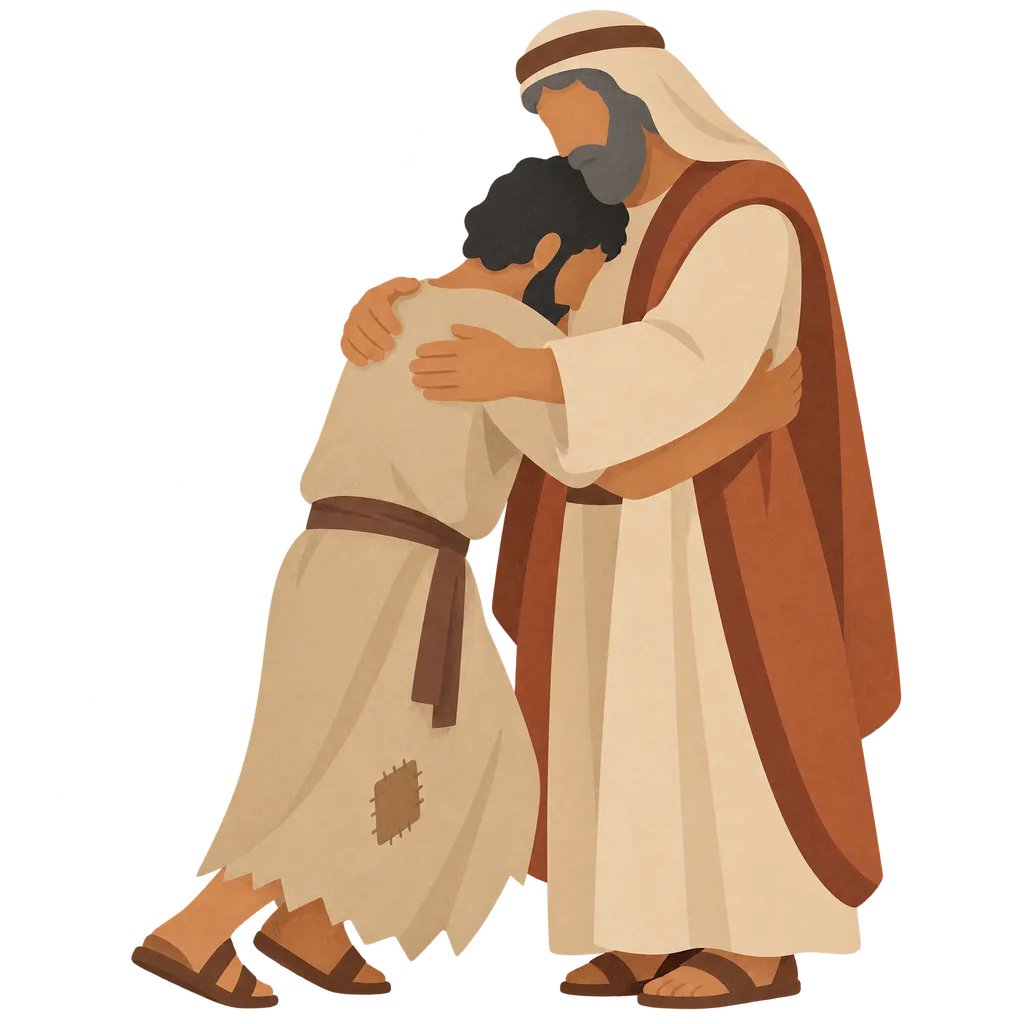
An older man with his arms around a younger man

The words in this story

13 words you will really use: they appear in the story and in the exercises, and come back for review in the next stories.

  • father

    a male parent

    noun

  • heaven

    the place where God lives; also the sky

    noun

  • servant

    a person who works for another person

    noun

  • hand

    the part of the body at the end of your arm

    noun

  • house

    a building where people live

    noun

  • gather

    to pick up things and bring them together

    verb

  • off

    away from a place (went off: went away)

    adverb

  • against

    toward someone who is wronged (sinned against you: did wrong to you)

    preposition

  • kill

    to make a person or an animal die

    verb

  • let

    to allow; Let’s eat: a way to say that we eat together

    verb

  • alive

    living; not dead

    adjective

  • therefore

    for this reason

    adverb

  • might

    a word that shows what someone wanted to be possible (so that I might be happy: so that I could be happy)

    verb

What you'll discover

The moments of the story, in the order they happen.

  1. A man has two sons; the younger one asks his father for his share and goes to a far country.

  2. He spends all he has, is sent to feed pigs and decides to go back to his father.

  3. His father sees him, runs to him and tells his servants to kill the fattened calf.

  4. The older son hears music and is angry, and his father comes out and speaks to him.

Original verse

The verse that closes the story, in the World English Bible. After 4 lessons, this is how you read it: the real text, with nothing simplified.

Luke 15:24 · WEB

for this, my son, was dead and is alive again. He was lost and is found.’ Then they began to celebrate.

Context

One detail about the scene, with the work it comes from.

The world of the story

What did the son ask for? Luke 15:12 says “my share of your property”. The Tyndale Open Study Notes say it was an appalling request: in effect the son tells his father that, to him, the father is dead, and there could be no greater insult to a father.

Source: Tyndale Open Study Notes · CC BY-SA 4.0

What a story looks like

First the whole story, in simple English with audio for every sentence. Then 4 short lessons, each with a piece of the story, a tip and exercises. At the end, the Bible verse and a little celebration.

  • The story · 22 sentences, with the meaning of each word on tap, 3 quick questions about the story
  • 4 lessons · a piece of the story, a tip and exercises in each one
  • The original verse · the Bible text, unadapted, then the next story

Questions about this story

Which passage does this story retell?

Luke 15:11-32, from the World English Bible: the story of the two sons.

What does the younger son ask his father for?

He asks for his share of the property, and the father divides his livelihood between his two sons (Luke 15:12).

What job does the younger son find in the far country?

A citizen of that country sends him into his fields to feed pigs (Luke 15:15).

What does the father do when he sees his son coming?

He runs to him, falls on his neck and kisses him, and tells his servants to bring a robe, a ring, sandals and the fattened calf (Luke 15:20-23).

How does the older son answer?

He is angry and will not go in; his father comes out and begs him, and the older son tells his father that he never got a goat (Luke 15:28-29).

Other questions:Do I need to know English?Does Biblup teach doctrine?

Start this story

22 sentences in simple English, with audio. The first lesson of the course needs no sign-up and no card.

Start this story
Only the necessary cookies, for now. Essential cookies are always on. Analytics is opt-in — you decide. Details