New TestamentBeginner I · Story 9Luke 2:4-20

The Baby in Bethlehem

Joseph and Mary travel to Bethlehem, where Mary gives birth and lays her son in a feeding trough. In the fields, an angel speaks to shepherds, and a heavenly army praises God. The shepherds go to see the baby. Read the story in simple English, with the real verses at the end.

Start this storyStory + 4 lessons · ~37 min · free
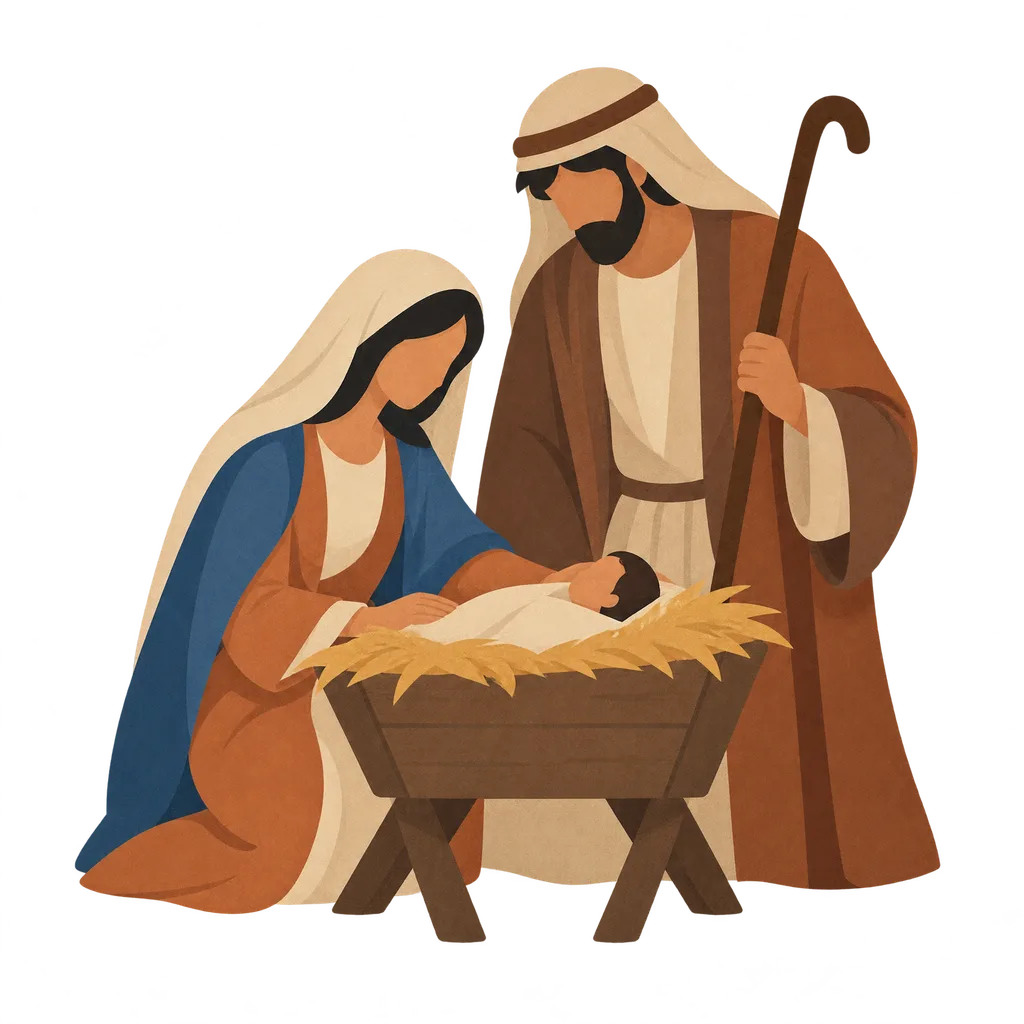
Mary and Joseph beside a baby lying in a feeding trough

The words in this story

14 words you will really use: they appear in the story and in the exercises, and come back for review in the next stories.

  • shepherd

    a person who takes care of sheep

    noun

  • field

    open land for crops or animals

    noun

  • angel

    a messenger from God

    noun

  • army

    a large group of soldiers

    noun

  • glory

    great honor and brightness

    noun

  • earth

    the world; the ground under the sky

    noun

  • thing

    an object or an idea

    noun

  • lay

    to put someone or something down in a place (laid: put down)

    verb

  • bring

    to take or carry something to someone (brought: took or carried to someone)

    verb

  • find

    to see or get something you were looking for (found: saw or got it)

    verb

  • speak

    to say words (spoke: said words)

    verb

  • tell

    to give someone information in words (told: gave information)

    verb

  • keep

    to hold or continue to have something; kept in her heart: remembered

    verb

  • lie

    to rest with the body flat or stretched out (lay: rested like this)

    verb

What you'll discover

The moments of the story, in the order they happen.

  1. Mary gives birth in Bethlehem and lays her son in a feeding trough.

  2. An angel brings news of a birth to shepherds keeping watch at night.

  3. The heavenly army speaks of glory and peace, and the shepherds set off for Bethlehem.

  4. The shepherds find the baby and tell what they heard; Mary keeps the sayings in her heart.

Original verse

The verse that closes the story, in the World English Bible. After 4 lessons, this is how you read it: the real text, with nothing simplified.

Luke 2:14 · WEB

“Glory to God in the highest, on earth peace, good will toward men.”

Context

One detail about the scene, with the work it comes from.

The world of the story

How did Mary care for her son? Luke 2:7 says she wrapped him in bands of cloth. The Tyndale Open Study Notes on Luke 2:7 describe this as a common practice showing motherly love and care.

Source: World English Bible · Public domain; Tyndale Open Study Notes · CC BY-SA 4.0
What a story looks like

First the whole story, in simple English with audio for every sentence. Then 4 short lessons, each with a piece of the story, a tip and exercises. At the end, the Bible verse and a little celebration.

  • The story · 25 sentences, with the meaning of each word on tap, 3 quick questions about the story
  • 4 lessons · a piece of the story, a tip and exercises in each one
  • The original verse · the Bible text, unadapted, then the next story

Questions about this story

Which passage does this story retell?

Luke 2:4-20, from the World English Bible: the birth in Bethlehem and the shepherds’ visit.

Why does Joseph go to Bethlehem?

He goes to enroll himself with Mary, because he belongs to the house and family of David (Luke 2:4-5).

Where does Mary lay her son?

She lays him in a feeding trough, because there is no room for them in the inn (Luke 2:7).

Who speaks to the shepherds?

An angel of the Lord speaks to them. Then a multitude of the heavenly army appears, praising God (Luke 2:9-14).

What happens after the shepherds arrive?

They find Mary, Joseph and the baby, and publicize what was spoken to them about the child. Mary keeps the sayings in her heart; the shepherds return praising God (Luke 2:16-20).

Other questions:Do I need to know English?Does Biblup teach doctrine?

Start this story

25 sentences in simple English, with audio. The first lesson of the course needs no sign-up and no card.

Start this story
Only the necessary cookies, for now. Essential cookies are always on. Analytics is opt-in — you decide. Details