Old TestamentBeginner I · Story 7Exodus 2:1-10

The Baby in the River

Exodus 2:1 to 10 tells how a woman of the house of Levi hides her baby son, then puts him in a basket at the river. His sister watches, and Pharaoh’s daughter finds him. His mother nurses him, and he becomes the daughter’s son, named Moses. Follow the story in simple English, then read the real verse.

Start this storyStory + 3 lessons · ~26 min · free
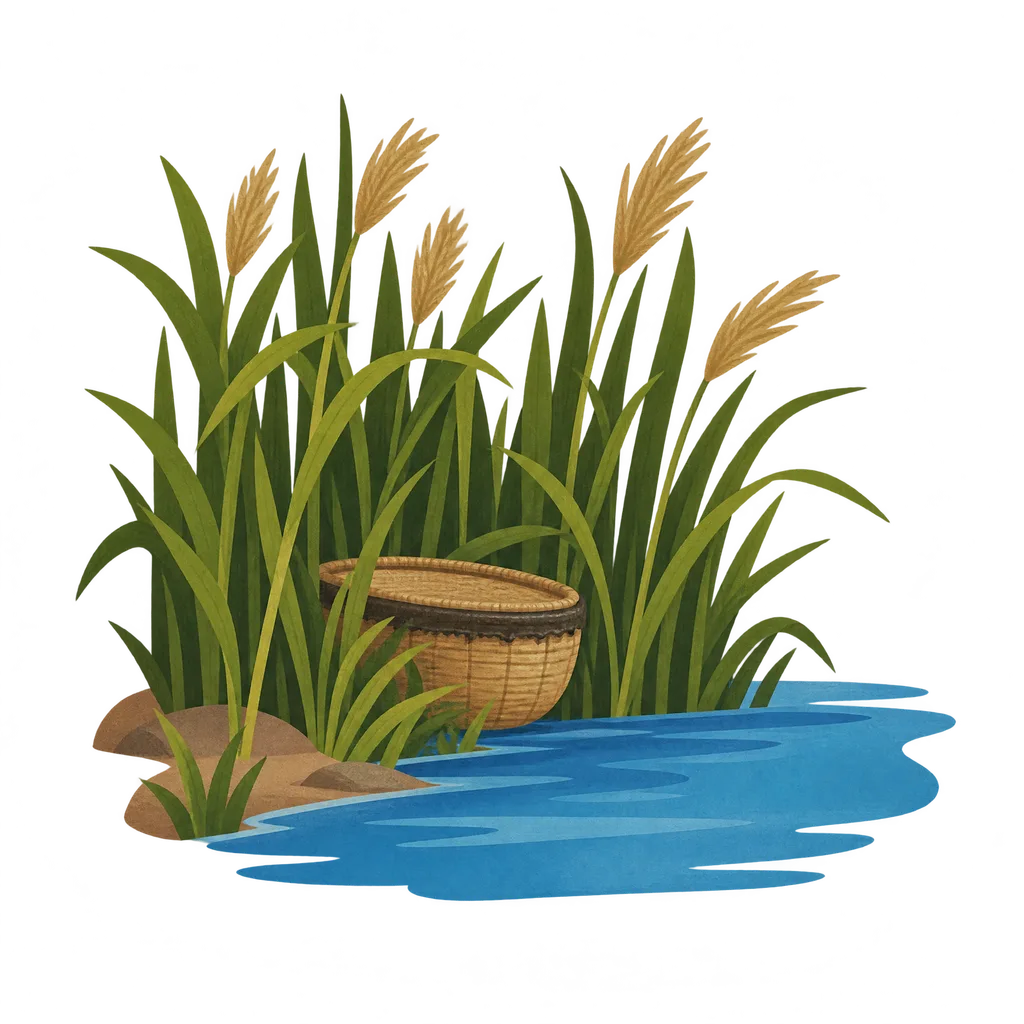
A small papyrus basket lies among tall reeds at the edge of a river

The words in this story

8 words you will really use: they appear in the story and in the exercises, and come back for review in the next stories.

  • house

    a building where people live; also all the people of one family

    noun

  • daughter

    a female child of a mother and a father

    noun

  • servant

    a person who works for another person

    noun

  • hide

    to put yourself, someone or something where nobody can see it

    verb

  • away

    to another place; not here

    adverb

  • would

    used to say what was going to happen, when you tell a story in the past

    verb

  • among

    in the middle of many people or things; also one of a group

    preposition

  • should

    shows what is a good thing to do

    verb

What you'll discover

The moments of the story, in the order they happen.

  1. A woman hides her son for three months, then puts him in a basket at the river. His sister watches.

  2. Pharaoh’s daughter comes to the river, sees the basket, and sends her servant. The baby cries.

  3. The child’s sister offers to call a nurse. Pharaoh’s daughter tells the child’s mother to take him and nurse him.

  4. The child grows and is brought to Pharaoh’s daughter. He becomes her son, and she names him Moses.

Original verse

The verse that closes the story, in the World English Bible. After 3 lessons, this is how you read it: the real text, with nothing simplified.

Exodus 2:10 · WEB

The child grew, and she brought him to Pharaoh’s daughter, and he became her son. She named him Moses, and said, “Because I drew him out of the water.”

The child grew, and she brought him to Pharaoh’s daughter, and he became her son. She named him Moses, and said, “Because I drew him out of the water.”

Credits

Context

One detail about the scene, with the work it comes from.

Who

Who were the man and the woman? Exodus 2:1 gives no names: the man was of the house of Levi, and the woman was a daughter of Levi. The Tyndale Open Study Notes name them Amram and Jochebed, and Exodus 6:20 says she bore Aaron and Moses.

Source: World English Bible · Public domain; Tyndale Open Study Notes · CC BY-SA 4.0
What a story looks like

First the whole story, in simple English with audio for every sentence. Then 3 short lessons, each with a piece of the story, a tip and exercises. At the end, the Bible verse and a little celebration.

  • The story · 20 sentences, with the meaning of each word on tap, 3 quick questions about the story
  • 3 lessons · a piece of the story, a tip and exercises in each one
  • The original verse · the Bible text, unadapted, then the next story

Questions about this story

Which Bible passage is this story from?

Exodus 2:1 to 10, in the World English Bible.

Where does the woman put her child?

In a papyrus basket, which she coats with tar and pitch and lays in the reeds by the river’s bank (Exodus 2:3).

Who finds the basket?

Pharaoh’s daughter, who comes down to the river and sees the basket among the reeds (Exodus 2:5).

Who asks about a nurse?

The child’s sister asks Pharaoh’s daughter whether she should go and call a nurse from the Hebrew women (Exodus 2:7).

Who gives the child his name?

Pharaoh’s daughter names him Moses, and says she drew him out of the water (Exodus 2:10).

Other questions:Do I need to know English?Does Biblup teach doctrine?

Start this story

20 sentences in simple English, with audio. The first lesson of the course needs no sign-up and no card.

Start this story
Only the necessary cookies, for now. Essential cookies are always on. Analytics is opt-in — you decide. Details