Old TestamentBeginner I · Story 8Exodus 3:1-12; Exodus 14:21-29

The Bush and the Sea

Exodus 3:1 to 12 and 14:21 to 29 tell two scenes. Moses finds a bush that burns but does not burn up, and God calls him by name and sends him to Pharaoh. Later the sea is divided, Israel walks through it on dry land, and the water returns over the Egyptian army. Read the story, then the real verse.

Start this storyStory + 4 lessons · ~37 min · free
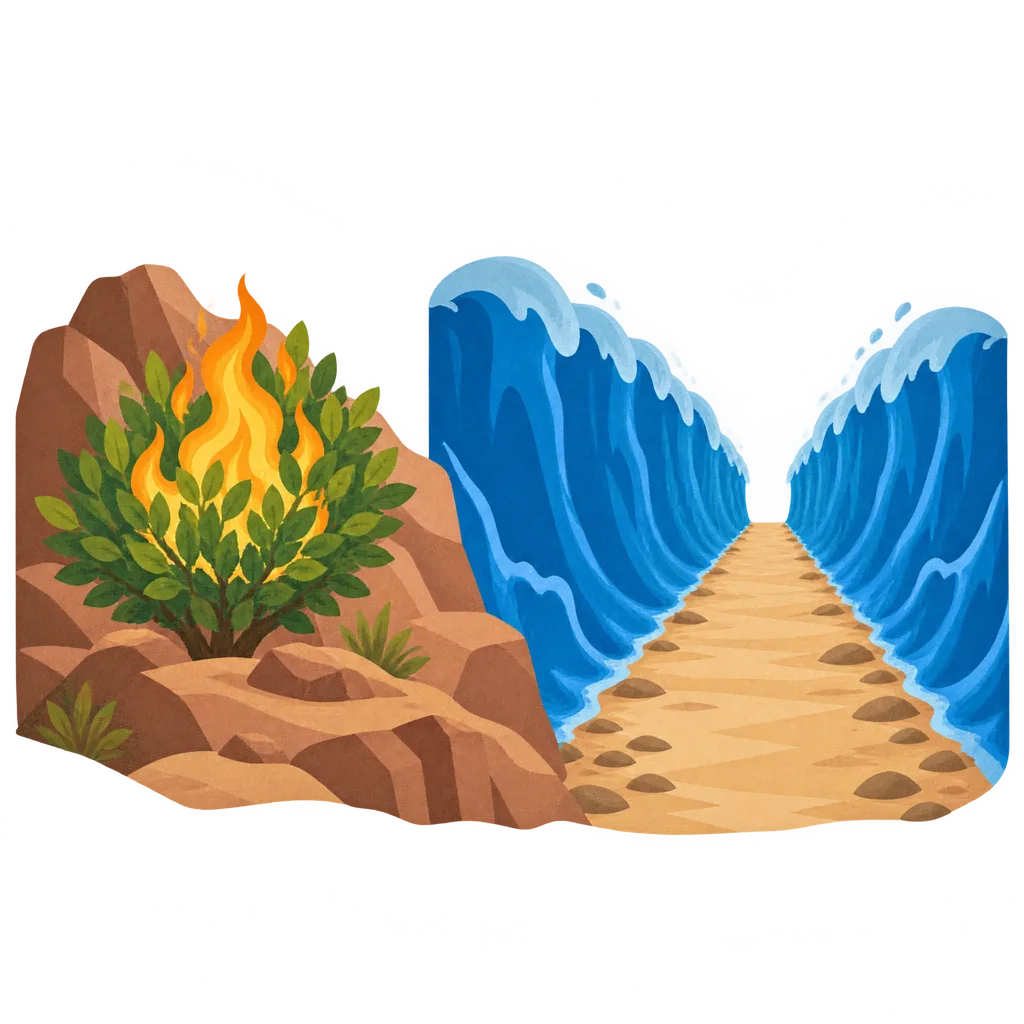
A bush with flames in it on a mountain, and a dry path between two walls of water

The words in this story

13 words you will really use: they appear in the story and in the exercises, and come back for review in the next stories.

  • priest

    a man who serves God in a holy place

    noun

  • fire

    something hot that gives light

    noun

  • place

    a part of the world; where something is

    noun

  • sea

    a very large salty area, much bigger than a river

    noun

  • water

    what you drink; rivers and rain are made of it

    noun

  • chariot

    a war cart pulled by horses

    noun

  • army

    a large group of soldiers

    noun

  • find

    to come upon something or someone, or to get it

    verb

  • here

    in this place

    adverb

  • send

    to make someone or something go to another place

    verb

  • bring

    to take someone or something with you to another place

    verb

  • walk

    to move on your feet

    verb

  • through

    from one side to the other, inside

    preposition

What you'll discover

The moments of the story, in the order they happen.

  1. Moses finds a bush on fire that does not burn up. God calls him by name, and he answers.

  2. God says he saw his people in Egypt, and he sends Moses to Pharaoh. Moses asks who he is.

  3. God makes dry land in the sea, and Israel walks into it, with a wall of water on each side.

  4. The Egyptians follow into the sea with chariots. In the morning the water returns and covers the army.

Original verse

The verse that closes the story, in the World English Bible. After 4 lessons, this is how you read it: the real text, with nothing simplified.

Exodus 14:22 · WEB

The children of Israel went into the middle of the sea on the dry ground; and the waters were a wall to them on their right hand and on their left.

The children of Israel went into the middle of the sea on the dry ground; and the waters were a wall to them on their right hand and on their left.

Credits

Context

One detail about the scene, with the work it comes from.

Who

Who was Jethro? Exodus 3:1 calls him the priest of Midian and the father-in-law of Moses. The unfoldingWord entry on Jethro and Reuel says both names refer to the father of Moses’ wife, Zipporah.

Source: World English Bible · Public domain; Translation Words (en_tw) · CC BY-SA 4.0
What a story looks like

First the whole story, in simple English with audio for every sentence. Then 4 short lessons, each with a piece of the story, a tip and exercises. At the end, the Bible verse and a little celebration.

  • The story · 19 sentences, with the meaning of each word on tap, 3 quick questions about the story
  • 4 lessons · a piece of the story, a tip and exercises in each one
  • The original verse · the Bible text, unadapted, then the next story

Questions about this story

Which Bible passage is this story from?

Exodus 3:1 to 12 and Exodus 14:21 to 29, in the World English Bible.

What does Moses see on the mountain?

A bush that burns with fire, and the bush is not consumed (Exodus 3:2).

Where does God send Moses?

To Pharaoh, so that Moses may bring the children of Israel out of Egypt (Exodus 3:10).

What happens to the sea?

The LORD causes the sea to go back by a strong east wind all night, and the waters are divided (Exodus 14:21).

What happens to the Egyptian army?

In the morning the waters return and cover the chariots and the horsemen, all of Pharaoh’s army that went in after Israel (Exodus 14:27-28).

Other questions:Do I need to know English?Does Biblup teach doctrine?

Start this story

19 sentences in simple English, with audio. The first lesson of the course needs no sign-up and no card.

Start this story
Only the necessary cookies, for now. Essential cookies are always on. Analytics is opt-in — you decide. Details